


If your goal is to grow your business in an introvert-friendly way (or just a way that saves your energy and gives you the highest ROI on content creation) this post is for you!
Strong writing doesn’t have to mean constant content creation. When your blog becomes the engine and your email becomes the invitation, your marketing starts working together, like magic! And if you ever want help building that kind of SEO-driven foundation, that’s exactly what I specialize in! Learn more here.
TL;DR (Overview)
Your blog is a searchable, long term asset and your email is the personal invitation back to it.
A calm, strategic system looks like this:
- Publish one SEO-focused blog post; it does the heavy lifting
- Pull one key idea to highlight in a single, focused email
- Use a simple writing email format so sending is easy
- Follow a repeatable workflow; no reinventing the wheel
- Invite readers back to your website with a clear link
That’s truly as easy as it gets! You’re basically setting up a system that works together to get more traffic back to your website and support your community at the same time!
Download Your FREE Cheat Sheet
The Plug-and-Play Blog Writing Prompts That Took My Traffic from 3K to 50K Impressions
This free cheat sheet will help grow your reach and visibility faster with AI prompts that will help you write each blog post faster and optimize it for SEO (Search Engine Optimization – think Google) and AEO (Answer Engine Optimization – think AI Search).
What Does “Blog Is the Engine, Email Is the Invitation” Mean?
This writing system is seriously so simple and sustainable!
- Your blog post does the heavy lifting (SEO, education, authority).
- Your email supports it (connection, community, sales).
The best part? Email writing becomes easier because you’re not coming up with something new every time you sit down to write. You’re repurposing something thoughtful you’ve already created.
Your blog:
- Appears in Search Results (Google/AI Search)
- Builds trust
- Lives on your website
Your email:
- Brings warm readers back to your blog
- Highlights one key idea
- Encourages action
Instead of treating blogging and writing emails as separate tasks, they become one connected ecosystem.
I’ll be honest, this has been the way I personally have attracted high paying clients and built my community intentionally!
Why This Works (Especially for Solopreneurs)
When you try to create separate content for your blog and your email list, you double your workload.
But when your writing flow works together, it saves you so much time!
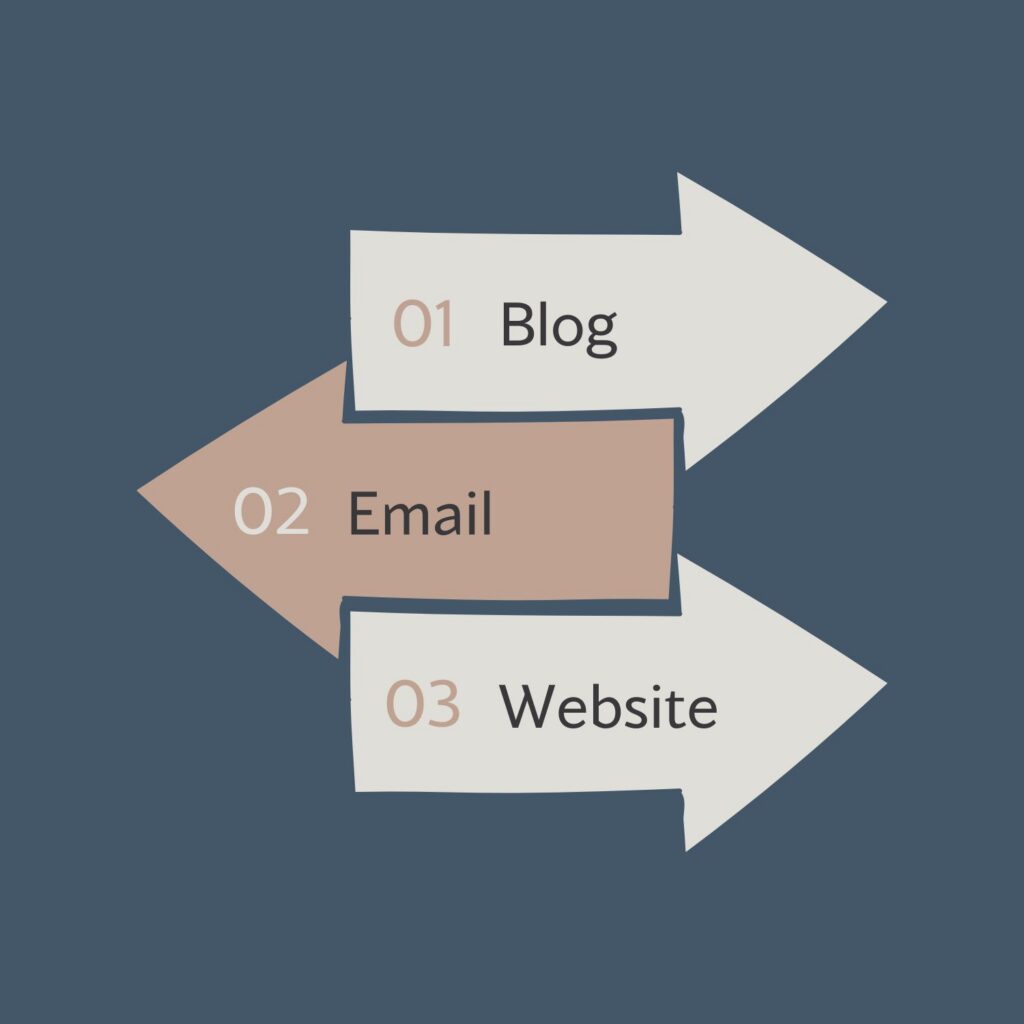
This way, you:
- Reduce decision fatigue
- Stay consistent
- Strengthen your SEO
- Build trust through repetition and consistently showing up
This builds you a system that feeds itself! Your blog attracts new readers, you get them onto your email list where you continue to share new blog posts. Sending your email subscribers back to your blog to continue learning from you!
You don’t need complicated funnels. You need alignment.
Step-by-Step: How to Turn One Blog Post Into One Strategic Email
1 – Publish an SEO-Focused Blog Post
Start with your long-form content.
Make sure that your blog post:
- Targets one specific cluster of keywords
- Solves one clear problem
- Includes a call to action
This is your engine that attracts your ideal clients. I do want to mention, because it’s super important, focus on SEO but also create content for your ideal client. We want to attract real people who are warm leads aka your ideal clients! In order to do this you want to make sure you are writing content they are actually searching for.
2 – Identify the Core Invitation
Ask yourself, what is the main takeaway from this specific blog post.
Not the entire post; just the heart of it.
Maybe it’s:
- A mistake people are making
- A mindset shift
- One actionable step
That becomes the focus of your email.
Remember, your blog post is a long-form piece of content. It goes in to depth and completely answers one specific problem your client might be dealing with. Your email does not have to be that in depth, or that long.
Your email should intrigue your subscribers to read more over on your blog. I also like to think of it this way, maybe a specific post isn’t for that client. They will know whether it’s something they want to hear more about or not from your email. Either way is okay, we want them to consume content that they truly resonate with!
The idea is that over time you are creating enough blog posts that more often than not your subscribers will want to learn more from you!
3 – Use a Simple Email Writing Format
I am all about making this easier! You don’t need a complicated email writing format to promote your blog.
Keep it clear. Skimmable. Intentional.
Here’s a clean structure you can reuse inside your writing email template:
Subject Line:
- One clear benefit
- Or one curiosity-driven hook
- Or one specific outcome
Hi [Name],
I just published a new blog post about [topic].
Here’s the part I really want you to think about:
• The core idea (one clear sentence)
• Why this matters (1–2 short sentences)
• What most people misunderstand (1 sentence)
• A simple shift or takeaway (1 sentence)
If this resonates, you can read the full post here:
→ [Insert link]
Talk soon,
[Your Name]
This structure is a great way to get to the heart of your blog without giving it all away. It peaks interest so your subscribers are excited to read more over on your blog!
The goal of this whole process is to make your life easier. I don’t want you to create from scratch every time you sit down to write because let’s face it, that’s exhausting!
With this email format, you’re not rewriting the entire blog post… you’re highlighting one meaningful piece of it.
That’s what makes this kind of email writing sustainable and why a consistent email writing format builds trust over time. Your readers can anticipate what they’re going to get when they open your emails! They know it’s no fluff, just to the point – valuable content!
4 – Create a Repeatable Writing Workflow (Not Just a Template)
Once you’ve chosen your core email writing format, the goal isn’t to reinvent it every time.
It’s to build a rhythm.
Instead of starting from scratch with every post:
- Publish your blog
- Pull one key idea
- Drop it into your saved writing email template
- Adjust tone slightly
- Insert the link
- Send
That’s it.
You’re not redesigning the structure; you’re reusing a proven system.
When your writing emails follow a consistent pattern, your readers know what to expect and you eliminate decision fatigue on your end.
Consistency builds trust.
Simplicity builds sustainability.
5 – Keep It Focused (Don’t Over-teach)
One of the biggest writing emails tips for blog promotion:
Don’t rewrite the entire post in the email.
The goal of email writing here isn’t to replace the blog. It’s to invite someone back to it.
Think of it like this:
- The blog is the full conversation.
- The email is the tap on the shoulder.

My Favorite Tools for Blog and Email Workflow
In order to make this system work you do need some tools to help you out!
Here are my favourite tools to keep this system running smoothly:
- Flodesk: My go-to for writing emails. It’s simple, beautiful, and makes sending intentional emails effortless.
- WordPress: Perfect for publishing SEO-focused blogs that attract your ideal clients!
- Showit: I love using Showit for my website because it lets me design a beautiful, flexible home for all my content.
Using tools you enjoy keeps your workflow calm, consistent, and much more sustainable. Which is exactly what this blog-to-email system is all about.
Can You Use AI for This?
Yes, email writing ai tools can help you:
- Summarize your blog post
- Rewrite sections more concisely
- Generate subject line ideas
But don’t skip editing. True email writing practice means refining the tone so it still sounds like you!
When someone gives you their email it’s so personal. They’re giving you permission to show up in their inbox and we shouldn’t take that lightly. I believe it takes a lot of trust for people to want to hand over that email even if it’s subconscious or a quick decision! Give your email subscribers your own words and guide them with a personalized invitation in their email to learn more over on your blog!
Use AI to support your writing, not replace it.
Writing Emails Tips for Blog Promotion
If your goal is traffic and connection, here are practical email writing tips:
- Keep emails between 150–300 words
- Use white space
- Link clearly (don’t hide it, make it easy for readers to know they can click on a link!)
- Only include one main CTA
- Write like you’re talking to one person, because you kinda are speaking directly to each subscriber!
FAQ
What is the difference between blogging and email writing?
Blogging builds searchable authority through long-form writing, while email writing builds connection by inviting readers back to your website or to buy/book with you.
How long should a blog promotion email be?
150–300 words is ideal for focused, clear writing emails.
Do I need a complicated email writing format?
No. A simple greeting, one key idea, and a clear link is an effective email writing format.
Can AI help with email writing practice?
Yes, email writing ai tools can assist with drafts, but personal editing improves tone and clarity.
How often should I email when I publish a blog?
At minimum, send one email per new post to maintain consistency and visibility.
TL;DR Recap
If you want marketing that feels calm and intentional:
- Let your blog do the heavy lifting; SEO, authority, and valuable content
- Pull one key idea to highlight in a single, focused email
- Use a simple writing email format to make sending easy
- Create a repeatable workflow so you’re not reinventing the wheel
- Invite readers back to your website with a clear link
Your blog is the engine, email is the invitation and your website is the home.
If you want help building a blog-first SEO system that naturally supports your email strategy, without burnout, that’s exactly what I help solopreneurs create through intentional SEO and website design! Book a free consultation to get started!
You’ll also love…
How to Make Your Habits Stick: The One Thing That Actually Works!
Personal Branding for Solopreneurs: A Simple 5 Step System That Grows With You
AI for Blog Writing: 5 Strategic Steps for Faster, SEO-Friendly Blog Posts
How to Grow an Online Business Without Becoming a Social Media Influencer
How to Blog Consistently Without Stress: The Cozy Creator’s Guide
